PowerShell 7+  ·  MIT License  ·  Open Source

NO-STEALER ENGINE

A comprehensive PowerShell scanning engine for detecting stealer-type malware on Windows. Chains hash, static, memory, C2, and behavioral analysis into a single tool.

6 Detection Layers
Free Always
MIT License
PS7+ Required
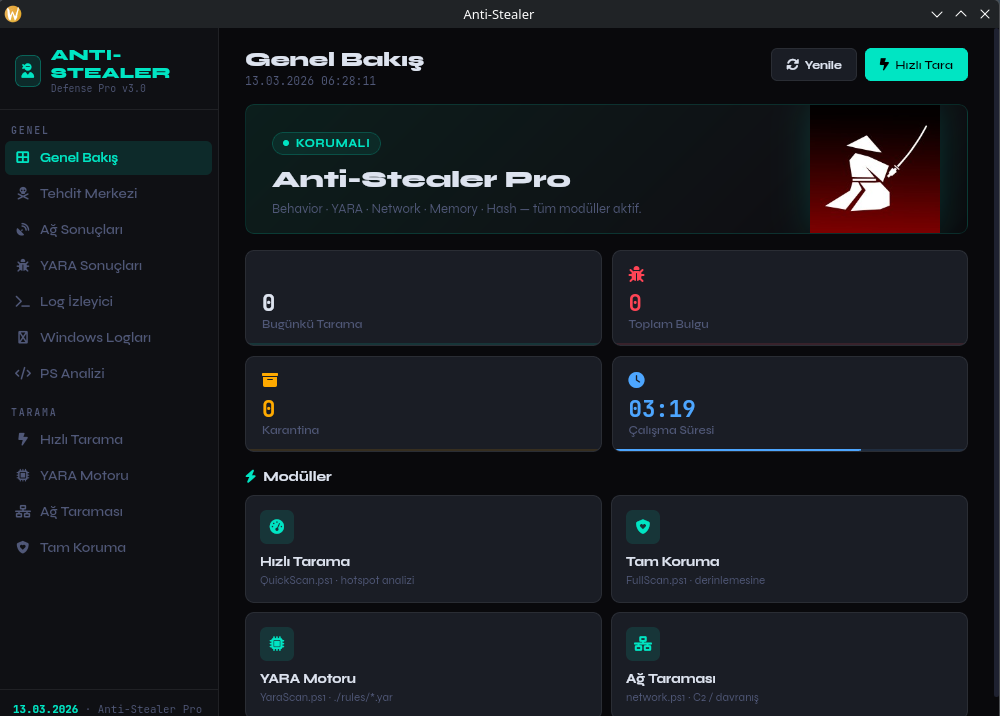
Anti-Stealer — UI
Anti-Stealer interface
REDLINE BLOCKED
VIDAR BLOCKED
PERION BLOCKED
MYTH STEALER BLOCKED
C2 COMMUNICATION DETECTED
MEMORY INJECT BLOCKED
RACCOON BLOCKED
TOKEN GRABBER BLOCKED
REDLINE BLOCKED
VIDAR BLOCKED
PERION BLOCKED
MYTH STEALER BLOCKED
C2 COMMUNICATION DETECTED
MEMORY INJECT BLOCKED
RACCOON BLOCKED
TOKEN GRABBER BLOCKED
Detection Modules

Six Layers.
Zero Escape.

Modules run sequentially, chaining static, memory, and behavioral analysis to catch what single-layer tools miss.

MODULE · 01
Hash-Based Detection

SHA256 exact match against a maintained database of known stealer binaries. Fastest path to a Confirmed verdict.

SHA256
MODULE · 02
Static Similarity

Extracts printable strings and scores similarity against signature sets. Catches polymorphic variants where hashes change but string patterns don't. Thresholds: 0.01 → Low / 0.08 → Potential.

JACCARD > 0.08
MODULE · 03
Memory Scan

Reads live process memory regions and matches against in-memory signatures. Detects injected payloads that never touch disk.

LIVE PROCESS
MODULE · 04
C2 Network Detection

Compares active TCP connections to a curated C2 IP/domain database. Returns Confirmed-C2 on a match — use results to generate firewall rules.

TCP · LIVE
MODULE · 05
Network Behavior

Rule-based checks: suspicious TLDs, non-standard ports, multiple simultaneous domains, and known-bad process names in outbound connections.

RULE-BASED
MODULE · 06
Behavioral Detection

Weighted Jaccard similarity across API calls, registry writes, file operations, and command-line patterns using NO-ST JSON rules. Threshold ≥ 0.30 triggers a finding; ≥ 0.60 is High risk.

NO-ST RULES
Installation

Up and Running
in Minutes

Requires PowerShell 7+ and Windows 10/11 (64-bit). Run as Administrator for full system access.

01.
Download the files

Download install.ps1 and kural.txt from the repository and place them in the same folder.

GITHUB
02.
Open PowerShell 7 as Admin

Right-click PowerShell 7 → Run as Administrator. Then bypass execution policy for the session.

ADMIN REQUIRED
03.
Run install.ps1 then 2.ps1

Execute both scripts in order from your folder. If you hit a Python build error, install C++ Build Tools from the Microsoft link, restart PowerShell, then run again.

PS7 REQUIRED
04.
Optional — Launch the GUI

Install pywebview via pip, then run UI.ps1 in PowerShell 7 (Admin) for the graphical interface.

UI.PS1
// quickstart PowerShell 7+
1 — Bypass execution policy
Set-ExecutionPolicy -Scope Process Bypass
2 — Run installer
# Replace with your actual path
C:\path\to\folder\install.ps1
3 — Run main script
C:\path\to\folder\2.ps1
4 — Optional GUI
# Install pywebview first
pip install pywebview
C:\path\to\folder\UI.ps1
Windows Defender may flag the scripts. Add a folder exclusion, run the scan, then remove it. Source code is fully auditable on GitHub.
⬇ View on GitHub
Who Is It For

Built for the
Security Community

Anti-Stealer is research-oriented — it generates shareable rules and structured telemetry, not just a pass/fail result.

🔬
Malware Researchers

Reverse-engineer stealer families, write and validate YARA/Sigma rules against a real multi-layer behavioral engine.

🛡️
AV / AM Engineers

Use NO-ST JSON rule output for signature generation, test automation, and AV vendor submissions.

🔔
SOC / IR Teams

Rapid on-host scanning, structured telemetry, and prioritized risk levels for fast incident triage.

🕵️
Threat Intel Teams

Expand C2 and SHA databases, export structured IoC data to open intelligence platforms.

Output Formats

Rules &
Reports

Every scan produces structured, shareable artefacts — not just a clean/infected verdict.

YARA
YARA Rules

Static string and byte-pattern rules ready for AV vendor submission or VirusTotal upload.

Sigma
Sigma Rules

Normalized behavioral patterns compatible with SIEM platforms and log-based detection pipelines.

JSON
NO-ST Rules

Structured API calls, registry, file, and network telemetry powering the behavioral detection module.

LOG
Per-Finding Reports

One JSON object per finding: module, risk level, family classification, PID, and similarity score.

Example NO-ST Rule
{
  "id": "no-st-0001",
  "family": "RedLine",
  "apicalls": [
    "CreateFileA",
    "WriteFile",
    "RegSetValueExA"
  ],
  "writtenfiles": [
    "%APPDATA%\\*\\logs.dat"
  ],
  "registry": [
    "HKCU\\Software\\*\\Config"
  ],
  "risk": "Confirmed",
  "jaccardScore": 0.74,
  "module": "BehaviorJaccard"
}
Open Source

Star it. Fork it.
Contribute.

Add signatures, tune Jaccard thresholds, or submit a PR with a new stealer family. The community makes the rules sharper.

★ Star on GitHub Open an Issue
FAQ

Common Questions

Yes, this is a false positive. Local PowerShell scripts that inspect live processes are sometimes caught by heuristic engines. The full source is on GitHub — audit every line before running. Add a folder exclusion in Defender, run the scan, then remove it.
The engine uses parallel job execution, modern .NET APIs, and module features unavailable in Windows PowerShell 5.1. Install PowerShell 7 from the Microsoft store or GitHub — it runs alongside the built-in version without conflict.
Confirmed means a direct SHA256 or exact C2 match — high confidence. Potential-Stealer means static similarity exceeded 0.08 or 20+ string matches were found without a hash hit. Treat it as suspicious and investigate, especially if combined with unusual network activity.
Analyse the sample in an isolated VM, extract API calls / registry patterns / strings, write a NO-ST JSON rule or YARA signature, test against both malicious and benign samples, then submit a pull request with sample metadata and test results.
No. Anti-Stealer runs entirely on-host. It reads outbound TCP connections to detect C2 traffic but makes no outbound calls itself. All reports and logs are written locally.